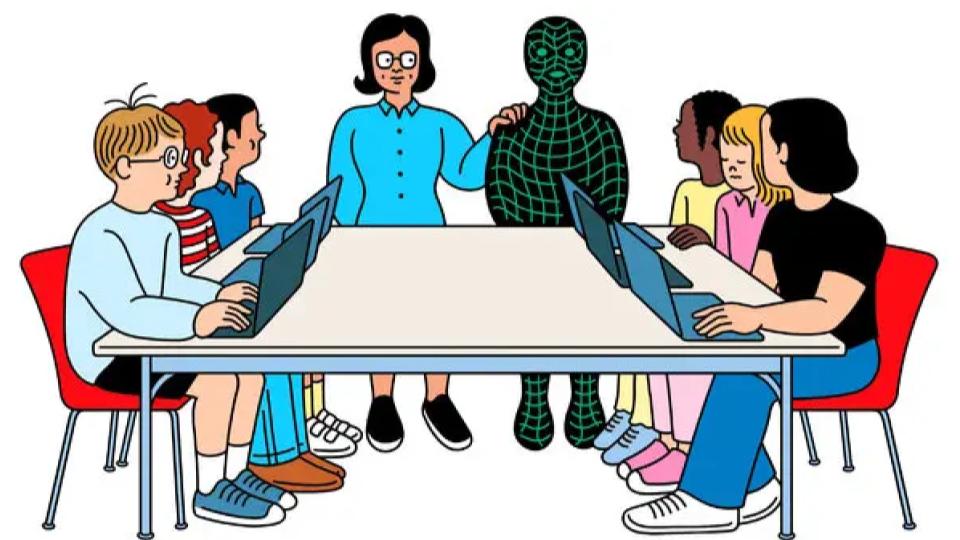
Immediately after its release in 2022, the internet was mesmerized by ChatGPT’s abilities. Within seconds, it could correctly solve complex equations or write an intelligent essay. It held power that was formerly only portrayed in science fiction. With its virality (now with around 193.33 million site visits per day) came an abundance of companies racing to get a grasp on the new craze. Brands started using the keyword “AI” as a marketing tactic–to ploy buyers into thinking their product is more advanced and trendy than before. Now, it seems that every large corporation has implemented some form of artificial intelligence into its software. Examples like Google AI and Microsoft’s Copilot both have a mission statement of implementing maximum intelligence and productivity into people’s everyday lives, which they succeed in doing. Using the web has become much more pleasant, whether researching or merely scrolling for fun.
But with all things viewed as “too good to be true,” the unjust downsides outweigh the ease of AI. What started as a tool for workers and students has infiltrated the creative space. Instagram hustlers encourage their audience to produce AI-generated songs, books, or videos as a way to make a quick buck. These videos gain millions of views, as their audience is willing to pay for the courses these influencers sell that teach them how to make hundreds of dollars a day with ChatGPT. Social media platforms are filled with images of impossible scenarios, with comments hyping up the creator, unaware that what they are watching was not made by a human.
The plague of “AI slop” – referring to profit-driven spam devoid of human touch – has caused skepticism in the creative space. Talented artists post to a crowd of people who denounce their hours of hard work put into a piece because they think it was AI-generated. How could you blame them? All creative fields are now so filled with believable AI that it is often more effective to assume that creators are using AI than to trust that they are not. Therefore, the use of AI to create art only causes harm to legitimate artists.
Those who defend AI art use a variety of arguments that generally boil down to this: it is just easier for them to use AI than to honestly create. To put what large ideas they have onto paper and have it turn out exactly as they imagine would take them years of hard work. Understandably, this realization is very discouraging. So, they turn to their trusty companion to create what they dream of in just seconds. Using AI creates the same outcome, but without the time and energy of learning the skill.
But what is an artist without the time spent and the mistakes made throughout the creative process? How did Pablo Picasso discover his love for cubism, or Degas his fascination with dancers? Years of experience, mistakes, and criticisms make an artist produce something with both skill and heart. Art is only art with the artist, and an artist is only an artist with the process. AI ‘artists’ have none of that.
AI-generated content is progressing too fast for the public to know how to handle it. With the ChatGPT app downloaded, one holds too much information and creative power than they know what to do with. This causes chaos. What needs to happen is the establishment of order regarding artificial intelligence. Transparency of what is and is not AI-generated will renew trust in creatives. However, at the rate that AI is advancing, it is logical to say that we may not be able to tell the difference very soon.